- May 21, 2026
- |Locksmith Services
- | 0

If you’ve ever stood in a Melbourne office reception with five different keys on a ring, trying each one until something opens, you already understand the problem a master key system solves.
Most growing businesses end up with a key for every door: front entry, back door, server room, stockroom, kitchen, two meeting rooms, the office above the shop, and an old padlock on a gate that nobody’s quite sure about. Staff carry whichever subset of keys their role demands; the manager carries them all, and somewhere in a drawer is a margarine container of “spares” that nobody can identify.
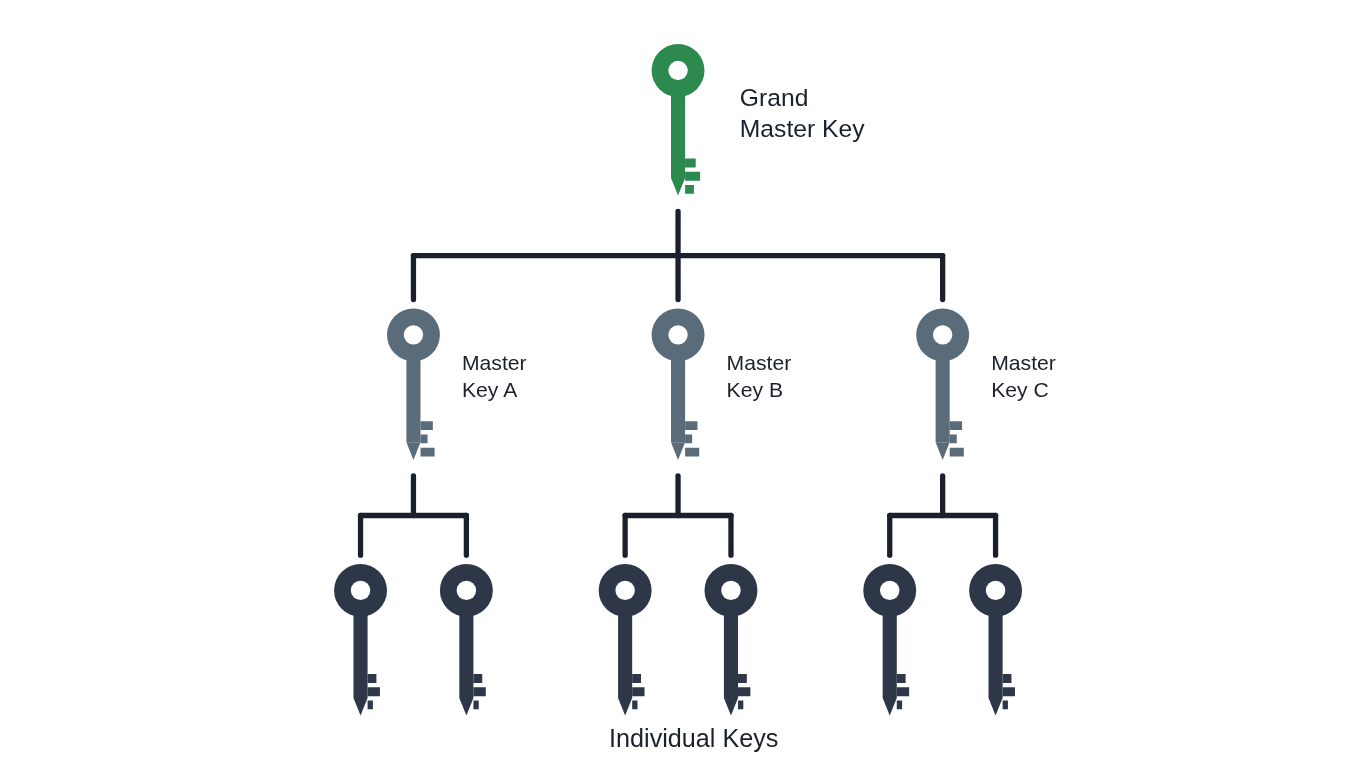
A master key system replaces that mess with a structured hierarchy. One key opens everything. Department heads carry keys that open their floor or section. Individual staff carry keys that open only the doors they need. It’s the same set of locks doing the same job, just keyed in a way that gives you control instead of chaos.
This post walks through how master key systems actually work, when they make sense for a business, what they cost in Melbourne, and where they go wrong if they’re set up by someone who doesn’t know what they’re doing.
What a master key system actually is
A master key system is a set of locks pinned so that more than one key will operate each cylinder. The trick is in the pinning, not the keys themselves.
Inside a standard lock cylinder, a row of small brass pins sits across the keyway. When the correct key is inserted, the cuts on the key push each pin to exactly the right height, and the cylinder turns. A master key system adds a second cut height to some of the pins, creating a “master shear line” alongside the regular one. Two different keys, cut differently, both line up the pins correctly, and both turn the lock.
Scale that up across a building, and you can build a hierarchy:
- The master key (or grand master) opens every lock in the system.
- Sub-master keys open a defined group of locks (a floor, a department, a building wing).
- Change keys open one specific lock and nothing else.
A small business might run a single-level system: one master, several change keys, no sub-masters. A multi-storey commercial property might run three or four levels, with grand masters, floor masters, department masters, and individual keys all active at once.
👉 How do factories make keys unique?
Why businesses end up wanting one
The reasons we hear most often, in roughly the order they come up in a phone call:
- Too many keys. A manager is carrying twelve keys and can’t remember which is which.
- Staff turnover. Someone has left, and there’s no record of which keys they had, or whether they returned them all.
- Access control gone wrong. A new staff member needs access to the front door and the kitchen but not the office, and currently the only options are “all the keys” or “ask someone every morning.”
- A break-in or near miss. After an incident, the question of who could have had a key becomes urgent and unanswerable.
- A new tenancy. Moving into a new commercial space and inheriting an unknown number of keys in circulation.
- Compliance pressure. An insurer, a parent company, or a property manager has asked for documented key control.
Every one of these is solvable with a master key system. Most of them are barely solvable without one.
What a master key system gives you
The benefits compound once the system is in place.
One key per role, not one key per door
A bookkeeper carries one key that opens the front door, the office, and the filing room. The cleaner carries one key that opens the front door, the kitchen, and the bathrooms. The manager carries one master key that opens everything. Nobody carries seven keys to do their job.
A clean answer to “who can get in where”
Because each key is cut to a specific level in the hierarchy, you can document exactly what every key opens. When someone leaves, you know which key to retrieve and what doors are exposed if you can’t.
Faster response when something changes
If a staff member loses a key, you can rekey just the locks that key opened, without touching the rest of the system. If you add a new door, it can be cut into the existing hierarchy without rekeying everything else.
Better security at the cylinder level
A properly designed master key system uses restricted keyways, which means the key blanks aren’t available at hardware stores. Only the locksmith on record can cut additional keys, and only with documented authorisation from the business. That eliminates the most common security failure in commercial buildings: keys being copied at the local cobbler without anyone noticing.
👉 Are all locksmiths licensed in Victoria?
Master keyed vs keyed alike: not the same thing
These two terms get mixed up constantly, and the difference matters.
Keyed alike means several locks are pinned identically so that one key opens all of them. There’s no hierarchy: every key opens every lock, or none of them. Useful for a small office where everyone needs access to everything, but not a real master key system.
Master keyed means each lock has its own change key, and a higher-level master key also operates it. The hierarchy is the point.
A surprising number of businesses think they have a master key system when they actually have a keyed-alike setup. The two look similar from the front desk; they’re very different from a security and management point of view.
When a master key system is the right call
Not every business needs one. The threshold depends on three things: how many doors you have, how many people need different access, and how often that mix changes.
Rough guide:
| Business size | Recommended approach |
|---|---|
| Under five doors and three staff | Keyed alike is usually fine. |
| Five to fifteen doors with role-based access needs | A single-level master key system is the sweet spot. |
| Fifteen-plus doors, multiple departments, or multi-tenancy buildings | A multi-level system with sub-masters is worth the design work. |
| High staff turnover or sensitive areas (cash handling, IT infrastructure, client records) | A restricted-key master system is worth it even at smaller scale. |
For businesses with very high turnover or strict audit requirements, an electronic access control system (key cards, fobs, mobile credentials) may be the better answer. The two aren’t mutually exclusive: many Melbourne offices run electronic access on the front entry and a mechanical master key system on internal doors.
👉 Are your office locks compliant with commercial standards in Victoria?
What it costs in Melbourne
Master key systems are quoted on the specifics of your building, so the numbers below are indicative rather than fixed. They reflect typical jobs we see across Melbourne.
| System size | Typical scope | Indicative cost |
|---|---|---|
| Small (5–10 cylinders) | Single-level system, standard commercial cylinders, restricted keyway | $800–$1,800 |
| Medium (10–25 cylinders) | Single or two-level system, restricted keyway, key control register | $1,800–$4,500 |
| Large (25–60 cylinders) | Multi-level with sub-masters, restricted high-security keyway | $4,500–$12,000 |
| Multi-building or multi-tenancy | Custom design, grand master and sub-master tiers, ongoing key control | Quoted per project |
The main cost drivers are the number of cylinders, the keyway used (standard vs restricted vs high-security restricted), the number of hierarchy levels, and whether existing locks can be re-pinned or need replacing.
A few things that aren’t always obvious in the headline price:
- Restricted keys cost more to cut, but that’s the trade-off for control. Expect $25 to $60 per additional key, depending on the keyway.
- A key register is part of the deliverable, not an extra. A good locksmith will set up a documented record of which keys are issued to whom.
- Existing locks can often be reused if they’re in good condition and use a compatible cylinder. This drops the cost meaningfully.
👉 How much does a locksmith cost in Melbourne?
Where master key systems go wrong
The failure modes are predictable, and almost all of them come from cutting corners during the design phase.
- Designed by someone without commercial experience. Master key systems require the locksmith to map out which keys operate which cylinders before any pinning happens. A poorly designed system creates “phantom keys” (accidental key combinations that open doors they shouldn’t).
- Standard keyway used instead of restricted. Cheap to set up, easy to defeat. Anyone can cut a copy at a kiosk, and the whole control structure collapses.
- No key register. The system is in place, but nobody’s tracking who has what. Within a year, it’s the same problem the master key was supposed to solve.
- Mixed brands and ages of cylinders. A master key system needs all cylinders to be from a compatible family. Trying to master-key a mix of old and new locks across multiple manufacturers usually means replacing several of them.
- Forgetting expansion room. A system designed exactly for today’s doors leaves no scope for growth. Good design leaves headroom for new doors and new hierarchy levels without redesigning from scratch.
What good design looks like
A licensed commercial locksmith designing a master key system should walk you through:
- A site survey of every door, lock, and access point.
- A user map of who needs to open what, by role rather than by name.
- A draft hierarchy showing master, sub-masters, and change keys before any cutting happens.
- A keyway recommendation with a clear explanation of restricted vs standard.
- A key control register template so you can track issued keys from day one.
- A plan for future growth, so adding a door in two years doesn’t require starting again.
If you’re being quoted on a master key system without a site survey and a written plan, that’s a sign to slow down.
👉 Top 5 mistakes to avoid when hiring a locksmith
VicLocks for master key systems in Kew and greater Melbourne
VicLocks designs and installs master key systems for businesses across Kew and greater Melbourne. We work with single-tenancy offices, multi-floor commercial buildings, retail premises, owners’ corporations, and trades businesses. Whether you’re starting from scratch or trying to bring order to a system that’s drifted over the years, the first step is the same: a site walk-through, a clear plan, and a written quote.
Contact VicLocks today on 0418 397 297 to book a master key system consultation.
Frequently Asked Questions
How long does it take to install a master key system?
For a small to medium business (up to 25 cylinders), most jobs are completed in a single day after the design is finalised. Larger multi-level systems can take two to three days on site, plus the upfront design work. Restricted key cutting can add a few days to the first delivery of keys.
Can my existing locks be converted to a master key system?
Often yes, provided they're from a compatible cylinder family and in good condition. A licensed locksmith can re-pin existing cylinders to fit a new master plan, which is significantly cheaper than replacing all the hardware. Where locks are mixed ages or brands, partial replacement is common.
What happens if I lose the master key?
If the master key was on a restricted keyway, the risk is contained because copies cannot be cut without authorisation. The standard response is to rekey the master level of the system, which means re-pinning every cylinder but reusing the change keys. Cost depends on system size, but it's far cheaper than replacing every lock.
Is a master key system less secure because one key opens everything?
Not if it's designed properly. A master key on a restricted keyway, held by a small number of named people and tracked in a register, is more secure than a building full of unrestricted keys floating around without records. The security risk isn't the master key itself; it's poor key control around it.
Can I add new doors to a master key system later?
Yes, if the system was designed with expansion in mind. A well-designed system leaves capacity for additional doors at every level of the hierarchy. Trying to extend a system that wasn't designed for it sometimes works and sometimes requires reworking part of the master plan.
Do I need a master key system or electronic access control?
Both have merits. Mechanical master key systems are robust, low-maintenance, and don't depend on power or software. Electronic access offers better audit trails, faster credential changes, and remote management. Many Melbourne businesses run a hybrid: electronic on external doors and high-security areas, mechanical master keys on everything else.
Where can I find a locksmith to install a master key system for my commercial business in Melbourne?
VicLocks designs and installs commercial master key systems across Kew and greater Melbourne. We're a fully licensed mobile locksmith working with offices, retail premises, owners' corporations, and multi-tenancy buildings, and we handle the full process: site survey, hierarchy design, keyway recommendation, installation, and a key control register so you have a documented record from day one. Call **0418 397 297** or contact us (https://viclocks.com.au/contacts/) through the website to book a consultation.