- May 4, 2026
- |Locksmith Services, Stats
- | 0

A wobbly door handle. A key that’s started sticking. A deadbolt that needs an extra shove to throw. These are the kinds of small, nagging problems that send people straight to YouTube on a Saturday morning. The repair looks straightforward, the hardware aisle at Bunnings is two suburbs away, and a locksmith feels like overkill for what’s clearly a five-minute job.
Then the screws strip. The new latch doesn’t sit quite right. The door won’t lock from the outside. And the small problem becomes a bigger, more expensive one.
We see this every week across Melbourne. Most callouts to fix a botched DIY repair end up costing more than the job would have if it had been done properly the first time. This post walks through the real costs that don’t show up on the receipt for a $14 strike plate, and where the line sits between sensible self-help and false economy.
Why DIY lock repair is so tempting
Locks look mechanically simple from the outside. There’s a knob, a latch, a couple of screws holding it all together. The repair video on YouTube is six minutes long, and the comments are encouraging.
For some jobs, that confidence is well placed. Tightening a loose handle, lubricating a sticky cylinder with graphite, or reattaching a strike plate that’s worked itself loose are all things a careful homeowner can do without trouble.
The problem is that **lock hardware is more delicate and more interconnected than it looks**. Inside a standard residential mortice lock, you’ve got a spring-loaded latch, a deadbolt mechanism, a cylinder factory-keyed to a specific cut, and tolerances measured in fractions of a millimetre. Get one of those out of alignment, and the lock will work, sort of, until it doesn’t.
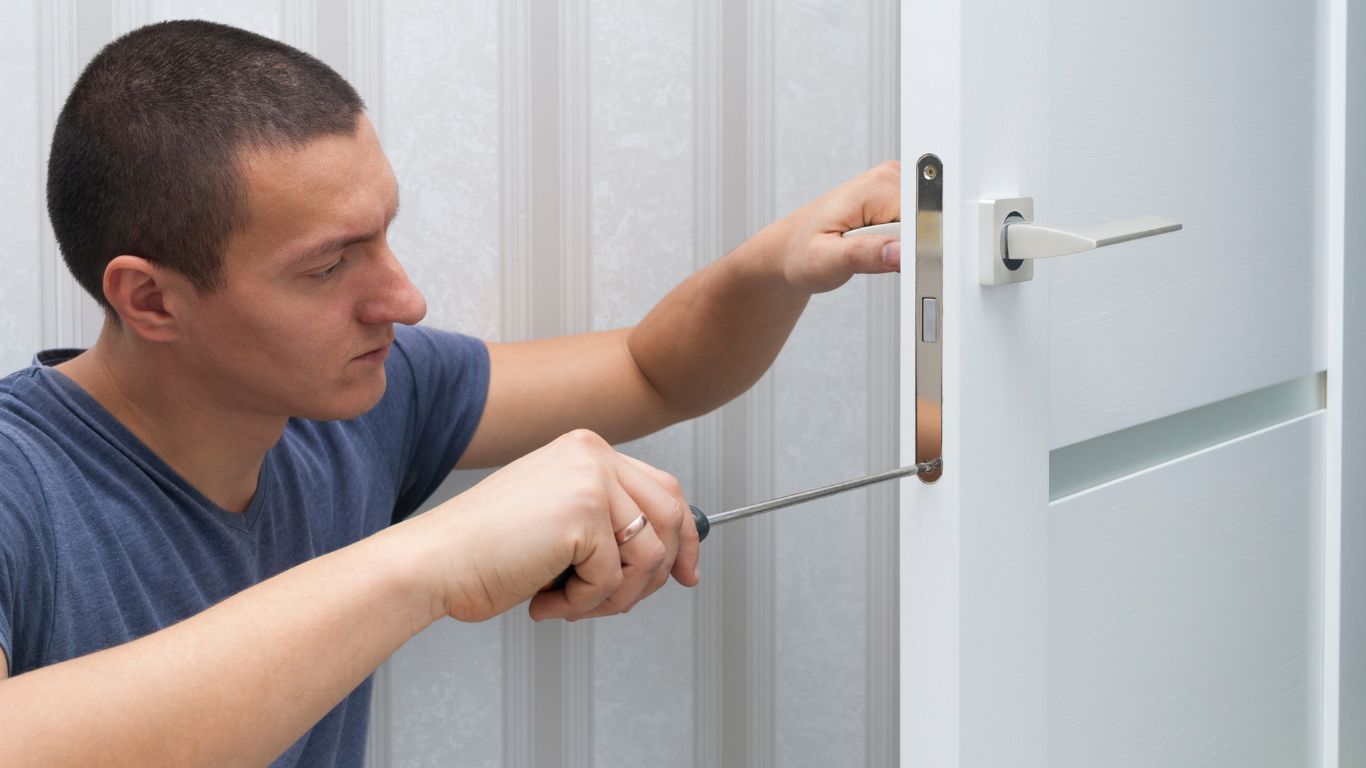
The most common DIY mistakes we’re called to fix
These are the jobs that come through our phones most often. None of them started out catastrophically. All of them ended with a locksmith on the doorstep.
Stipped screws and damaged housings
The single most common DIY casualty is a stripped screw inside a door handle or lockset. Once the head is chewed out, the lock can’t be removed cleanly, and what should have been a quick swap becomes a drill-out job. **Drilling adds labour, and often a new lock body**, because the original is no longer salvageable.
Misaligned strike plates
Strike plate replacement is a classic Saturday project. The new plate goes on, the screws bite, the door closes, and the deadbolt won’t throw. A strike plate that’s even two millimetres out will stop a deadbolt from engaging properly. People then force the door, which deforms the latch, which means a new lock.
The wrong replacement part
Walk into a hardware store with a photo of the old lock on your phone, and you’ll often walk out with a lock that “looks the same.” Australian residential doors use a mix of imperial and metric backsets, and the cheap replacement frequently doesn’t match. We’ve seen doors with two sets of mismatched holes drilled through them because the second attempt didn’t fit either.
The half-finished rekey attempt
Rekey kits sold online promise that you can re-pin your own cylinders for the price of a takeaway. In practice, dropping the tiny pins and springs into a sink, a carpet, or the wrong chamber is the rule rather than the exception. A botched rekey leaves you with a cylinder that turns but doesn’t lock, or locks but won’t unlock.
👉 How locksmiths open locks without damaging them
The real costs that don’t show up on the receipt
The list price of a replacement lock is the smallest part of the bill when DIY goes wrong. Here’s how the costs actually stack up in our experience.
| Cost category | DIY assumption | What it often becomes |
|---|---|---|
| Hardware | $20–$60 for a like-for-like replacement | $80–$250 once a damaged lock body or door edge needs replacing |
| Locksmith callout | Avoided entirely | $130–$250 standard callout in Melbourne, more after hours |
| Time | A Saturday afternoon | Two days locked out of a back door, or a Monday morning emergency |
| Security gap | Not considered | A door that latches but doesn’t deadbolt is effectively unlocked |
| Insurance | Assumed unaffected | Claims can be questioned where a non-licensed repair contributed to a break-in |
The security gap point is the one most people underestimate. A deadbolt that engages weakly, or a strike plate that’s been forced into position, looks fine from inside the house. From the outside, it’s the kind of door a casual intruder can shoulder open in seconds. We’ve attended jobs where a “working” DIY repair held up for months, only to fail at the worst possible moment.
The insurance point is harder to pin down because it depends on your policy. Most home and contents policies in Victoria require that you take reasonable care of your property. A lock that’s been visibly hacked at, drilled into, or fitted with mismatched hardware can give an insurer grounds to ask harder questions if a claim is lodged. It rarely voids a policy outright, but it can slow a claim down at the worst time.
👉 How much does a locksmith cost in Melbourne?
When DIY actually makes sense
Not every lock issue needs a professional. Done sensibly, these are reasonable jobs to take on yourself:
| DIY job | What’s involved |
|---|---|
| Tightening loose screws | Snug up screws on a handle, escutcheon, or strike plate, provided they still bite cleanly into solid timber. |
| Lubricating a sticky cylinder | Use a small amount of graphite powder or a dry PTFE spray. Avoid WD-40 and other oil-based sprays, which collect dust inside the cylinder and make the problem worse. |
| Replacing a like-for-like interior door knob | Fine on a bedroom, bathroom, or linen cupboard door where security isn’t a factor. Match the backset and spindle before buying. |
| Cleaning a gummed-up key | Warm soapy water and a soft toothbrush is enough. Dry thoroughly before use. |
| Adjusting a sliding door roller | Turn the access screw at the base of the door in quarter turns to lift or drop the roller where it’s dragging on the track. |
Anything beyond that, especially anything involving the external door of your home or business, is worth a second thought.
When to skip DIY and call a licensed locksmith
These are the jobs where a professional saves you money on the second visit, not the first:
- The lock has been tampered with or shows signs of attempted picking. Forensic damage is easy to miss and expensive to ignore.
- You’re rekeying after moving house or after losing a key. Cylinder work is fiddly, and the failure mode is subtle.
- The deadbolt won’t throw, won’t retract, or feels gritty when turned. Internal damage rarely fixes itself and usually gets worse with use.
- You’re upgrading to a smart lock or electronic deadbolt. These need a clean install and correct strike alignment to function reliably.
- You’re working on a commercial premises, rental, or strata property where licensed work is either required or strongly preferred for compliance reasons.
In Victoria, locksmiths must hold a Private Security Business Licence issued through Victoria Police. That licensing exists precisely because the work has security and legal implications that a tutorial video can’t cover.
👉 Are all locksmiths licensed in Victoria?
👉 When to change or rekey your locks
What a professional repair actually includes
- A licensed locksmith doesn’t just swap parts. A standard residential repair visit usually covers:Diagnosis of the actual fault, which is often different from what the customer assumed.
- Inspection of the door, frame, and strike alignment, since lock issues are frequently door-alignment issues in disguise.
- Like-for-like or upgraded replacement hardware with the correct backset, faceplate, and finish.
- Rekeying where appropriate, so existing keys still work, or new keys cut on the spot.
- A check on the rest of the home’s locks for the same wear pattern, before it becomes the next callout.The end result is a door that locks cleanly, a key that turns smoothly, and no need for a follow-up visit.
VicLocks in Kew and Greater Melbourne
VicLocks is a fully licensed mobile locksmith covering Kew and greater Melbourne.
We handle residential repairs, rekeys, lock upgrades, emergency lockouts, and post-break-in work across the inner east, the northern suburbs, and beyond.
If you’ve started a DIY repair and hit a wall, we’d much rather you stop and call than push through and turn a small job into a big one. Most of the time, we can have it sorted the same day, often within a couple of hours.
Contact VicLocks today on 0418 397 297 for a quick, honest quote.
Frequently Asked Questions
Is it illegal to repair my own locks in Victoria?
No. Repairing locks on a property you own or rent is legal. Selling locksmithing services to others, rekeying for hire, or working on third-party properties without a licence is what’s regulated under Victoria’s Private Security Act.
How much does it cost to fix a botched DIY lock repair?
In Melbourne, a standard callout to repair a failed DIY job typically runs from $130 to $250 for the visit, plus any replacement hardware. Costs rise after hours, on weekends, or when the door itself has been damaged. Pricing is indicative and depends on the specific job.
Will my home insurance cover damage from a DIY lock repair gone wrong?
It depends on the policy. Most home and contents policies expect a reasonable standard of care for the property. Visible DIY damage to a lock or door can complicate a claim, particularly after a break-in. Check your specific policy wording, or ring your insurer if you’re unsure.
Can I rekey my own locks with an online kit?
You can, but it’s the most common DIY job we get called to finish. Rekey kits work in principle, but they require steady hands, the right pin sizes, and a clean working environment. Dropping a single pin or spring is usually enough to ruin the cylinder.
What’s the safest DIY lock job for a homeowner?
Lubrication and tightening loose screws. A graphite or dry PTFE spray on a sticky cylinder, and a screwdriver applied carefully to any handle that’s worked itself loose, will solve a meaningful share of household lock complaints without risking damage.
When should I call a locksmith instead of trying it myself?
Any time the lock involves an external door, a deadbolt that won’t throw, a key that has broken off in the cylinder, a recent move, a recent break-in, or a smart lock install. The repair will be cheaper and faster done once, properly.