- July 22, 2026
- |Locksmith Services
- | 0
Locks are the quiet workhorses of home security. They sit between your home and the outside world every single day, and a little care keeps them turning smoothly for years rather than seizing up at the worst possible moment. The good news is that lock maintenance is simple, quick, and mostly about doing a few small things right and avoiding one big mistake.
Here is how to keep your locks in good shape, starting with the question our locksmiths get asked more than any other.
What is the best way to lubricate a lock?
Lubrication is the single most important part of lock maintenance, and it is also where most people go wrong. So let us start with the mistake to avoid.
Do not use WD-40 or other oil sprays on your locks. It is tempting, and the lock will feel better for a day or two, but oil-based sprays attract dust and grit and slowly gum up the pins inside the cylinder. Over time the lock stiffens and can seize entirely. As a one-off cleaner to flush out an already gummy lock it has a place, but only if you then flush it and re-lubricate with a proper dry lubricant.
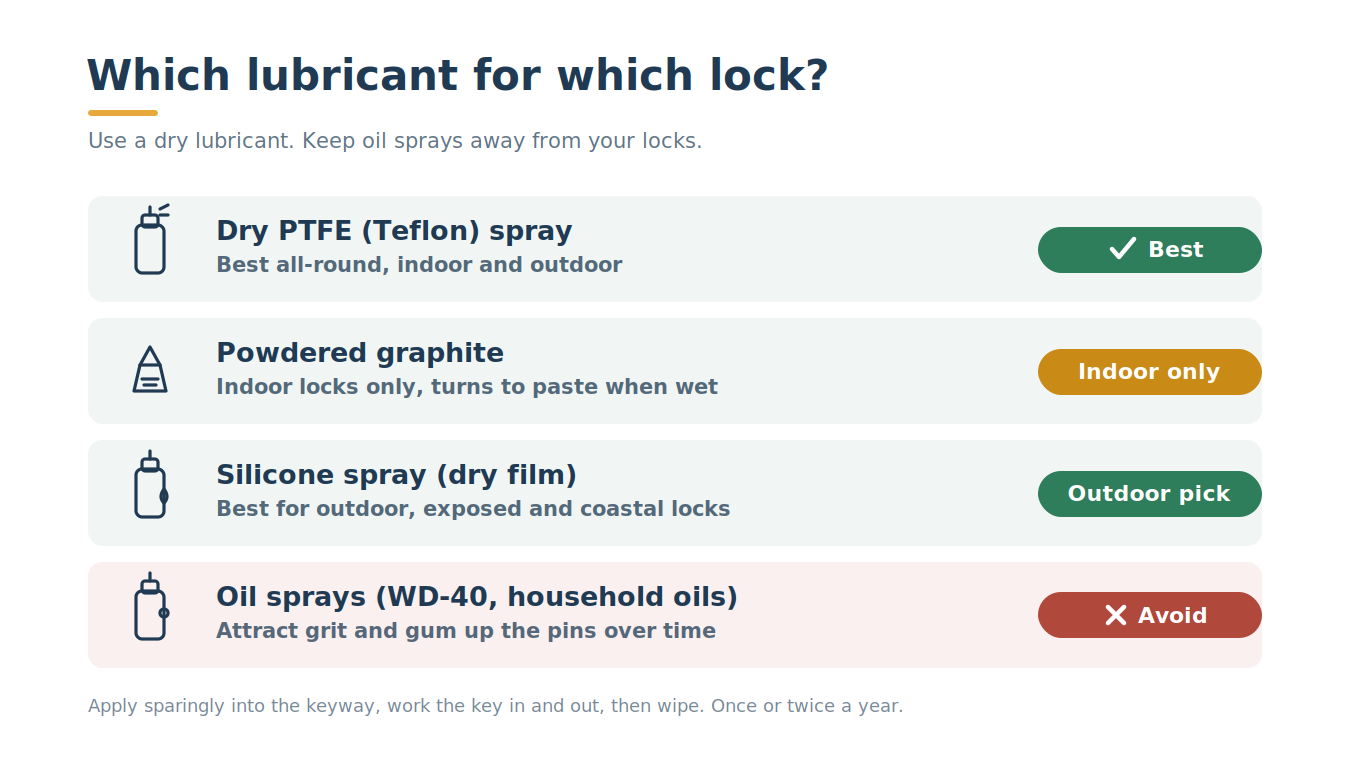
For actual lubrication, use a dry lubricant. Here is which type suits which lock.
| Lubricant | Best for | Notes |
|---|---|---|
| Dry PTFE (Teflon) spray | The best all-round choice, indoor and outdoor | Goes on wet, then dries to a slick film that does not attract dust |
| Powdered graphite | Indoor locks and deadbolts | Traditional and effective, but messy, and it turns to paste on wet or outdoor locks, so keep it indoors |
| Silicone spray (dry film) | Outdoor, exposed and coastal locks | Water-repellent and resists corrosion, which suits Melbourne’s bayside and weather-exposed doors |
| Oil sprays (WD-40, household oils) | Avoid as a lubricant | They attract grit and gum up the pins over time. There are dry PTFE products, including one from WD-40’s own range, that are fine, but the classic oil spray is not |
How to apply it: use it sparingly. A small puff of graphite or a quick spritz of dry spray into the keyway and onto the bolt is plenty. Insert your key and work it in and out a dozen times to spread the lubricant through the mechanism, then wipe the key and the face of the lock. Once or twice a year is enough for most locks, and every three to six months for exposed or coastal ones.
More ways to keep your locks in good shape
Lubrication does most of the work, but a few simple habits keep the whole system healthy.
- Keep your locks and keys clean. Dirt and grime make a key harder to insert and turn. Wipe the lock face and the key with a damp cloth and dry them off. If the keyway itself is dirty, flush it with a dry lubricant and work the key in and out rather than poking cotton buds inside, which can leave fibres behind.
- Do not force a sticking key. A key that is getting harder to turn is telling you something. Forcing it risks snapping the key in the lock. Clean and lubricate first, and if it is still stiff, get it looked at before it fails completely.
- Avoid slamming doors. The repeated impact can knock the lock mechanism out of alignment or damage the door frame, leading to trouble locking and unlocking. Closing doors gently genuinely extends the life of a lock.
- Make sure the door is hung correctly. A dropped or misaligned door puts constant strain on the bolt and strike plate and wears the lock out early. If the door drags or the bolt does not line up cleanly, the hinges or alignment may need adjusting.
- Tighten loose hardware. Handles, strike plates and screws work loose over time. A periodic check and a turn of the screwdriver keeps everything seated and reduces wear.
- Protect your exterior locks from the weather. Melbourne’s swings from wet winters to hot summers, and salt air in bayside suburbs, are hard on outdoor locks. A silicone spray a couple of times a year helps keep rust and corrosion at bay.
For a sense of what a locksmith visit costs if you would rather have it done professionally, our Melbourne guide breaks it down:
👉 How Much Does a Locksmith Cost in Melbourne?
When maintenance is not enough
Maintenance extends a lock’s life, but it cannot revive one that is worn out. Here is the honest rule of thumb: if a lock stays stiff even after you have cleaned and lubricated it, the key or the internal cylinder is probably worn, and lubricant is only masking the problem. At that point, forcing more life out of it usually ends in a snapped key or a lockout.
A few signs it is time to repair, rekey or replace rather than maintain:
- The key sticks or catches even after cleaning and lubricating.
- The lock turns roughly, grinds, or the key has to be jiggled to work.
- There is visible rust, damage, or play in the cylinder.
- You have lost a key, moved into a new home, or suspect the lock has been interfered with.
If any of those ring true, rekeying is often the most cost-effective fix, and it is worth knowing the difference between rekeying and replacing:
👉 When to Change or Rekey Your Locks
👉 How to Tell if a Lock Has Been Tampered With
Keeping your locks healthy in Kew and greater Melbourne
Good lock maintenance is not about security alone; it is about getting the most out of the hardware you already have. A dry lubricant, a clean key, gentle doors and a well-hung frame will keep most locks turning smoothly for years.
When a lock is past saving, or you would simply rather leave it to a professional, VicLocks works across Kew and greater Melbourne on lock repairs, rekeying, replacements and broader home security:
👉 Residential Security Services
👉 Emergency Locksmith in Kew
Contact VicLocks today or call 0418 397 297 for advice, a service, or a lock that has finally given up.
Frequently Asked Questions
Can I use WD-40 on my locks?
It is best not to. Regular WD-40 and other oil sprays attract dust and grit and gum up the pins inside the lock over time, so a lock that works at first will start to stiffen and can eventually seize. Use a dry lubricant instead. WD-40 does make a separate dry PTFE product that is suitable, but the classic oil spray is not.
What is the best lubricant for a door lock?
A dry PTFE (Teflon) spray is the best all-round choice for indoor and outdoor locks, because it dries to a slick film that does not attract dust. Powdered graphite is fine for indoor locks, and a silicone spray suits outdoor and coastal locks where moisture is a concern.
How often should I lubricate my locks?
Once or twice a year is enough for most locks. Exterior, exposed or coastal locks benefit from more frequent attention, roughly every three to six months, because weather and salt air are harder on them.
Why is my key hard to turn?
Usually dirt or a lack of lubrication, both of which are easy to fix. Clean the key and keyway and apply a dry lubricant first. If the key is still hard to turn after that, the key or the cylinder is likely worn and should be looked at before it fails.
How do I look after outdoor locks in Melbourne?
Keep them clean and use a silicone or dry PTFE spray a couple of times a year to repel moisture and resist corrosion, which is especially worthwhile in bayside and weather-exposed areas. Avoid graphite outdoors, as it turns to paste when it gets wet.