- July 14, 2026
- |Insurance
- | 0

Does insurance cover a locksmith?
It depends on why you need one. Insurance will often help with the cost of replacing or recoding locks after a break-in or when your keys are stolen, because that is an insured event. It is much less likely to cover a simple lockout, a lost set of keys, or a lock that has simply worn out. Nearly every policy applies limits, an excess and conditions.
That is the honest, general answer.
Insurance policies vary widely across providers and product tiers, so please treat everything below as background information rather than advice on your particular cover. Your Product Disclosure Statement (PDS) and your insurer are the only sources that can tell you what you are actually covered for. We are locksmiths, not insurance advisers.
With that said, here is how it typically works and the questions worth asking.
When does insurance usually cover a locksmith?
The pattern across most home policies comes down to a single question: was there an insured event? A theft or a break-in is an insured event. Losing your keys at the pub, or pulling the door shut behind you with the keys on the bench, generally is not.
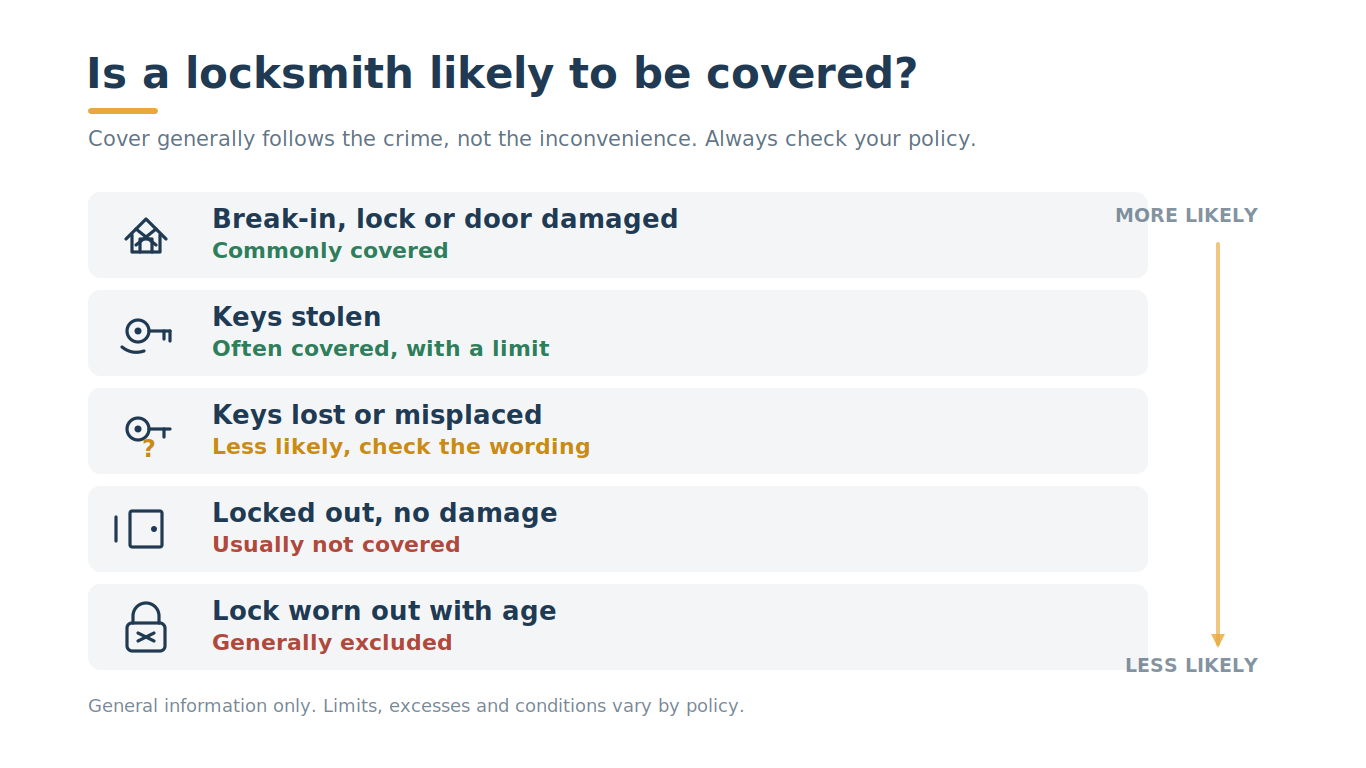
| Situation | Typical likelihood of cover | What to check in your policy |
|---|---|---|
| Break-in, with a lock or door damaged | Commonly covered as part of the claim | Whether lock repair and replacement is included, and the claim limit |
| Keys stolen (theft, mugging, burglary) | Often covered, and many insurers state a specific limit for replacing or recoding external locks | The cap per incident, the excess, and whether a police report number is required |
| Keys lost or misplaced | Less likely, and some policies cover stolen keys but not lost ones | Whether “lost” keys are named separately from “stolen” keys |
| Locked out (keys inside, no damage) | Usually not covered as a claim, though some policies include an emergency assistance service | Whether your policy has home emergency assistance, and what it actually pays for |
| Lock worn out or failed with age | Generally not covered, as wear and tear is a standard exclusion | The maintenance and wear-and-tear exclusions |
The practical takeaway is that cover follows the crime, not the inconvenience. If someone has taken your keys or forced your door, you have a reasonable case to look into. If you have simply locked yourself out, expect to pay for the callout yourself, and our Melbourne cost guide will tell you what that should look like:
👉 How Much Does a Locksmith Cost in Melbourne?
👉 Do Locksmiths Charge Call-Out Fees in Melbourne?
Does home insurance cover a locksmith?
Often, in the right circumstances. Many Australian home and contents policies include cover for replacing or recoding the locks on external doors and windows if your keys are stolen, up to a stated limit that varies by insurer and policy tier. Some policies also offer an emergency assistance service, which can send a tradesperson (a locksmith among them) when something sudden and unforeseen leaves the home insecure.
What is far less commonly covered is the everyday stuff: lost keys, a standard lockout, or a lock that has simply given up after twenty years. Those tend to sit outside the policy, and where cover does exist, it is often an optional add-on rather than a default inclusion.
Three things worth knowing before you assume either way:
- “Stolen” and “lost” are not the same word to an insurer. Some policies cover one and not the other.
- There is usually a limit and an excess. If the excess is close to the cost of the job, claiming may not be worth it.
- Who lost the keys can matter. Some policies only cover the policyholder and immediate household.
Does business insurance cover a locksmith?
For commercial premises, cover is more commonly available, but it is still rarely automatic. Some business insurance products include locksmith or lock replacement costs, and others offer it as an option you need to select rather than something included by default.
If you run a business and access control matters to you (multiple doors, staff keys, a restricted key system), it is worth raising locksmith and lock replacement cover with your broker or insurer directly, and reviewing it alongside your physical security setup:
The general principle holds here too: a claim is far more likely to succeed when the locksmith work follows a break-in, theft or attempted forced entry, rather than an everyday lockout.
How to protect a potential claim
If something has happened and you think you may have a claim, a few practical steps make life easier. In our experience, these are the things people wish they had known at the time.
- Report a theft or break-in to the police and get a report or event number. Some policies will not consider a stolen-keys claim without one.
- Contact your insurer before authorising work where the situation safely allows it. Some insurers prefer to arrange the locksmith themselves or require an approved one.
- Use a qualified locksmith. A poorly fitted lock can leave your home insecure and can undermine a future claim if a break-in follows.
- Keep the invoice and take photos of the damage before the work is done.
- Secure the property first if it is unsafe. Your safety comes before the paperwork, and most insurers expect you to take reasonable steps to prevent further loss.
If you are not sure whether a lock has actually been tampered with, this guide covers the signs:
👉 How to Tell if a Lock Has Been Tampered With
Locksmith and lock replacement help in Kew and greater Melbourne
Whether or not your insurer covers the bill, the first priority after a theft or break-in is making your home or business secure again. VicLocks works across Kew and greater Melbourne on lock repairs, replacements, rekeying and emergency callouts, and we can provide a clear invoice for your insurer if you decide to claim.
👉 Residential Security Services
Contact VicLocks today or call 0418 397 297, and we will get your property secure first.
This article is general information only and is not insurance or financial advice. Cover varies between policies, and your PDS and your insurer are the only reliable guides to what you are covered for.
Frequently Asked Questions
Does home insurance cover a locksmith?
Sometimes, depending on the circumstances. Many Australian home policies cover replacing or recoding external locks when keys are stolen, up to a set limit, and some include an emergency assistance service. Lost keys and everyday lockouts are far less likely to be covered. Check your PDS or ask your insurer.
Does insurance cover lost keys?
Often not, and this is the distinction that catches people out. A number of policies cover keys that are stolen but exclude keys that are simply lost or misplaced. The wording in your policy matters, so it is worth reading how it defines each.
Will insurance cover a locksmith if I lock myself out?
Usually not as a claim, because no insured event has occurred and there is no theft or damage. Some policies include a home emergency assistance service that may help, but for a standard lockout, you should expect to pay the callout yourself.
Does insurance cover lock replacement after a break-in?
This is the strongest case for cover. Damage to locks and doors during a break-in is commonly included as part of a burglary claim, subject to your limit and excess. Report it to police, photograph the damage, and keep the locksmith's invoice.
Should I call my insurer or a locksmith first?
If the property is insecure or you are unsafe, make it secure first. Otherwise, it is worth contacting your insurer before authorising work, since some prefer to arrange or approve the locksmith. Always use a qualified locksmith, because a badly fitted lock can affect a future claim.
Does business insurance cover a locksmith?
More often than home insurance does, but it is still frequently an option rather than a default inclusion. If lock and key security matters to your premises, raise it specifically with your broker or insurer rather than assuming it is covered.